
It’s been 19 years since his demise, yet Tupac Shakur’s influence can still be seen and heard today. This infographic looks at lyrics from his album, The Don Killuminati: 7 Day Theory (released under the alias Makaveli) and political theorist Niccolo Machiavelli and excerpts from his most famous work, The Prince.

“Life Goes On” (Intro)
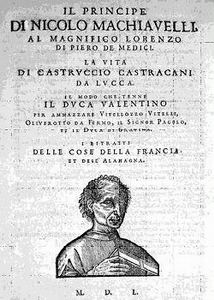
The Prince (Il principe) is the most notable work of Italian politician Niccolo Machiavelli. The treatise was written in hopes to regain a political appointment with the Medici family. Machiavelli held a political office under the reigning family and after their expulsion in 1498 with the Floretine chancellery. In 1512, the Medicis overthrew the governing republic and Machiavelli was ousted out of office. Although the manuscript of The Prince existed since 1513, it wasn’t officially published until 1532, five years after Machiavelli’s death. Rapper Tupac Shakur adopted the moniker “Makaveli”, a nod to the philosopher and made the album Don Killuminati: 7 Day Theory (DKSDT). The album was released approximately two months later after Shakur was murdered in 1996.
“Spark the Brain” (Influences)
Machiavelli uses his observations and political references such as Alexander the Great and Cesar Borgia to write The Prince. Similarly, Tupac, rather Makaveli, uses Machiavelli’s political ideology, Shakur’s own experiences and the teachings of Black Panther members/political prisoners: Mutulu Shakur, Geronimo Pratt, Mumia Abu Jamal, Sekou Odinga, also referred to as “the real O.G.’s.”
To this day, the Machiavelli’s treatise is still read and analyzed by political science students, scholars, and theorists while those who seek or are in power put it into practice. During the Enlightenment period, Thomas Hobbes, the scientific English version of Machiavelli published the comparable Leviathan (1651) while essayist and royal advisor Sir Francis Bacon studied Machiavelli and wrote, “We are much beholden to Machiavelli and others, that write what men do, and not what they ought to do.” Robert Greene’s The 48 Laws of Power is the modern-day Machiavellian handbook to acquiring power. According to Greene, the moves and strategies of rapper 50 Cent has earned him the title of the “New Prince” and together they co-wrote The 50th Law. The resistance to the influence of The Prince was illustrated when the Vatican banned it during Machiavelli’s lifetime (it was reproduced under different guises). After it was officially published in 1513, it was banned again in 1559 for being Anti-Christian.
Then there is Makaveli’s influence which is “worldwide like the art of graffiti.” Music has that power. It even spread to of all places—the Vatican. After Shakur’s death, his song “Changes” (said to be recorded under the moniker Makaveli) was added to the Vatican’s Myspace playlist because he was considered one of the artists who aimed “to reach the heart of good minded people.”
“I’m not saying I’m gonna change the world, but I guarantee that I will spark the brain that will change the world.”
–Tupac Shakur
When we hear rappers like Kendrick Lamar or J. Cole, Shakur’s influence can be heard coming through the speakers. These two artists are carrying the torch while setting their own trail ablaze. Then there is poet and activist Nikki Giovanni. Before Makavelli was born, Giovanni began her own legacy as a voice for the people and an outlaw in her own right. Like so many, she mourned his death and once stated, “sometimes if we don’t protect the outlaws, we can’t protect the good guys.” Giovanni’s left forearm bears a “Thug Life” tattoo. The same letters Makaveli boasted on his usually shirtless and defined abs; an acronym of a warning for all to see: “The Hate U Give Little Infants F**k Everybody.” After the rappers death, Giovanni also wrote a riveting poem, “All Eyez on U” a take on Shakur’s double album, “All Eyez on Me” (also the first album where Shakur addresses himself as Makaveli). There are countless books about the slain rapper and numerous celebrities mention his influence. Even 50 Cent rapped, “I want them to love me like they love Pac.” It is yet to see who will change the world, but his presence is still felt.
“Heartz of Men” (Misunderstood)
The Prince is said to be one of two things. First, the treatise is a plea to get his job back from the Medici family. The Prince would prove Machiavelli a valuable asset and Lorenzo Medici would rehire him. The other theory is that The Prince was a satire to ruin the Medici family. By following the manual, the Medicis would create unrest and be ousted out of power. Most believe it is the former and anything clever and dishonest to gain power is considered “Machiavellian.” It did not help that the first translations were sensationalized and exasperated the immorality in the book. Either way, till this day the work is still (mis)quoted to satisfy a viewpoint.
For the Machiavelli of the 1990’s, rap music has always been associated with violence and misogyny. When the lyrics of 2Pacalypse Now was said to be responsible for the killing of a state trooper, VP Dan Quayle used Shakur as an easy target to attack rap music. However, the ‘hoods knew better, the social commentary and lyrical documentation of Black America such as “Brenda’s Got a Baby” created an alliance to the rapper. Politician C. Delores Tucker also came for the late rapper for his misogyny despite his track empowering women, “Keep Ya Head Up.”

It is also said that Shakur threw “salt in the game” for all the negativity he rapped about or said in interviews. Tracks like “Hit ‘Em Up” that targeted the Notorious B.I.G., his wife and his crew wasn’t moving rap music forward. The “coastal beef” ended with their untimely deaths. Both men said it was just between the two of them—sorta. Even though Makaveli came for Mobb Deep, Nas and Jay-Z, members of his group “Outlaws” represent New Jersey and he was tight with Treach from Naughty by Nature (who has Tupac tatted on his arm and they shared the silver screen in Juice). Shakur also recorded “Old School” about the New York he grew up in. The sensationalized beef was bigger than the two men. In the introduction “Bomb First (My Second Reply)” of DKSDT, he begins, “It’s not about East or West” and proclaims, “It’s about ni**as and b***hes, power and money, riders and punks, which side are you on?”
“Blasphemy” (Morality)
Machiavelli rejected morality in The Prince. The book was written in the Renaissance, a time when humanism was taking hold. Humanism emphasizes the thoughts and actions of the self instead of the influence of the divine with concepts of “individual expression” and “intellectual freedom.” During this period, people looked to Greco-Roman classical ideologies from philosophers such as Plato and Aristotle. Part of the reason why The Prince is considered so ruthless is because it lacks a Godly morality.
“…a prudent ruler ought not to keep faith when by so doing it would be against his interest, and when the reasons which made him bind himself no longer exist. If men were all good, this precept would not be a good one; but as they are bad, and would not observe their faith with you, so you are not bound to keep faith with them.”
–Machiavelli, The Prince
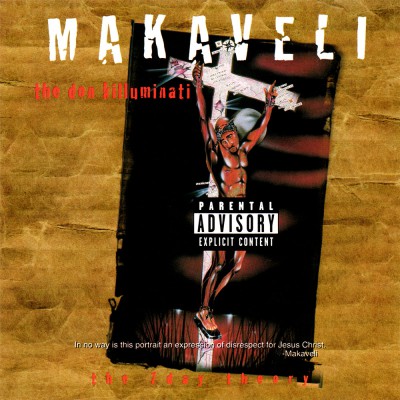
In regards to DKSDT, the musical production is flooded with religious references including tracks titled “Blasphemy” and “Hail Mary”; having an excerpt from a Christian public access program “This Week In Bible Prophecy”; a reciting of “The Lord’s Prayer”; several biblical metaphors; and the album depicting the slain rapper as Jesus on the cross.* However, the album deals with morality in a dichotomous way. On one side, he warns of the nature of ill-hearted men and expresses attacking his enemies before they get the opportunity. On the other hand, Makaveli heeds to having morals and people to change their harmful ways.
In between his plans of attacks and the transformation to better one’s self, Makaveli expresses his distrust for religion and denounces the corruption of the church in the track “Blasphemy.” Then at the very end of the track, he raps about the pureness of his heart, but wonders if heaven is another “closed door” (another challenge of being black) that he has to face:
I leave this and hope God can see my heart is pure
Is heaven just another door? I leave this here
I leave this and hope God see my heart is pure
Is heaven just another door?
–Makaveli, “Blasphemy”, DKSDT
“Last Wordz” (Outro)
So who is more influential, Makaveli or Machiavelli? Both were renaissance men in their respective times. They both had political upbringings. They were both praised and blamed. Both men communicated pragmatically. They both had their works analyzed and taught in college courses. They both serve(d) a purpose in political agendas. Most importantly, the two men have influenced many.**
I argue, if it wasn’t for Machiavelli there wouldn’t be a Makavelli, however, if it wasn’t for Tupac would I even be discussing Machiavelli?
*An excerpt of Minister Louis Farrakhan is used in a political context.
**It doesn’t make sense to compare book to music sales, as The Prince is now in the free domain and been around for 500 years and Shakur work has sold millions and bootlegged. It is fair enough to say that they both “get around”.
Acknowledgements: Special shout out to Dr. L. Chewy for sparking the idea. To DJ and CJ, I wasn’t finished. To The WB and Splenda, thanks for the checks and balances, nah mean.
Updated: November 2, 2015

 kashema
Leave a comment